Click HERE to return to all rocks.
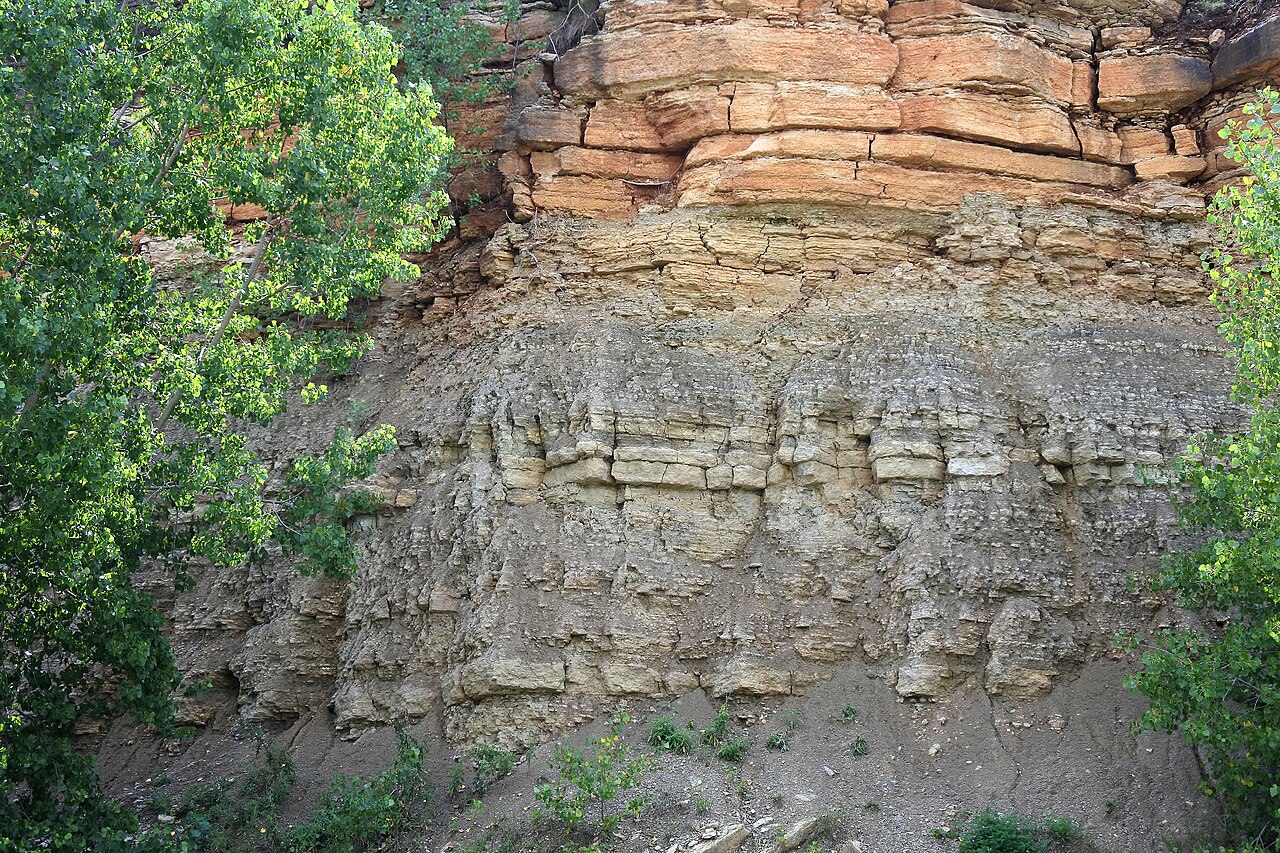
Photo of the Decorah Shale (gray/green layers) in Decorah, Iowa, the type locality of the unit. Image credit: Wilson44691, CC0, https://commons.wikimedia.org/w/index.php?curid=50426512 🗗
The Decorah Shale overlies the uppermost member of the Platteville Formation. It has both shale and limestone beds. It is largely not visible in outcrops along the Mississippi River Gorge in the Twin Cities (It is estimated to be present in only 25 of the 3,000 square miles of the Twin Cities metro area). It seems to have a conformable contact with the Carimona member of the Platteville–that is, the silty and clayey sediments were deposited immediately after the deposition of the limestone. The Decorah has a maximum thickness of about 90 feet.
This formation has many fossils: brachiopods, bryozoans, crinoids, snail shells, and trilobites, among others. It has thin beds of bentonite (volcanic ash), similar to the Carimona member of the Platteville, just below.
It is heavily fractured/broken and weathered due to being exposed at the surface prior to the deposition of glacial till.
The Decorah has been used for brick-making.
Mossler, John H.. (1985). RI-33 Sedimentology of the Middle Ordovician Platteville Formation Southeastern Minnesota. Retrieved from the University Digital Conservancy, https://hdl.handle.net/11299/60754🗗
https://equatorialminnesota.blogspot.com/2016/01/the-decorah-shale.html🗗
https://equatorialminnesota.blogspot.com/2014/02/practical-guide-to-mnrrametro-area.html#more🗗
https://www.pca.state.mn.us/sites/default/files/mm-overview.pdf 🗗